

What's the Difference Between Kickboxing and Muay Thai?
Published by 10th Planet Beaumont · October 6, 2026
If you've been looking at striking classes in Beaumont, you've probably run into both names — and maybe wondered whether they're the same thing with a different label. They're not. Kickboxing and Muay Thai are close cousins, but they fight with different tools, at different ranges, with a different rhythm.
Here's the quick version, then the details that actually matter when you're deciding which one to try.
The Short Answer
Kickboxing is striking with your fists and your legs — punches and kicks. Muay Thai keeps all of that and adds your elbows, your knees, and the clinch. That's why Muay Thai is nicknamed "the art of eight limbs": two fists, two elbows, two knees, and two shins, all in play.
So everything kickboxing does lives inside Muay Thai's bigger toolbox — but kickboxing's smaller toolbox is faster to pick up and a phenomenal workout. Neither is "better." They're built for different things.
What Is Kickboxing?
Kickboxing is a modern hybrid — it took shape in the 1960s and '70s when karate practitioners and boxers started blending full-contact punches with kicks. Today "kickboxing" is really an umbrella term covering a few rulesets (American, Dutch, K-1), but they share a core: punches and kicks, kept standing, at a fast pace.
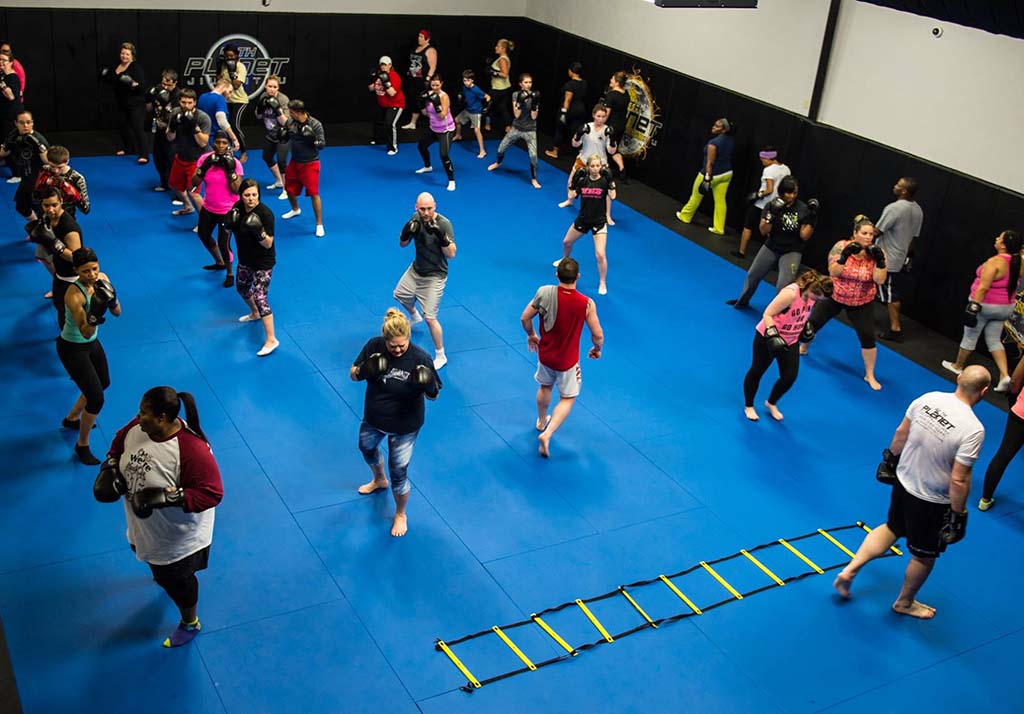
What that looks like on the floor:
- Weapons: Fists and feet — four points of contact.
- Kicks: Often aimed at the body and head; many rulesets limit or skip low leg kicks.
- No clinch, elbows, or knees in most formats — when fighters tie up, the referee breaks them apart.
- Pace: Quick hands, lots of combinations, constant movement — one of the best cardio workouts you'll ever do.
If your goals are conditioning, stress relief, and learning to throw a clean, powerful combination, our kickboxing classes are an approachable place to start. We broke down why in Why Kickboxing Beats Traditional Gym Cardio.
What Is Muay Thai?
Muay Thai is centuries old — the national sport of Thailand, refined over generations and battle-tested in rings around the world. It takes everything kickboxing does and opens up three more weapons: elbows, knees, and the clinch.
The differences you'll feel right away:
- Eight weapons: Fists, elbows, knees, and shins.
- The clinch: Muay Thai fighters grab, control, off-balance, and land knees from close range. The clinch is practically its own sport inside the sport.
- Shin kicks and leg kicks: Kicks land with the hardened shin, rotate through the target, and routinely attack the legs — the low kick is a signature weapon.
- The teep (push kick): A long-range "jab with the foot" used to control distance.
- Rhythm: More deliberate and balanced — power over volume, with constant checks and counters.
Because it covers every range of a standing fight, Muay Thai is one of the most complete striking arts for self-defense and the striking base most MMA fighters build on. We covered the payoff in 7 Benefits of Muay Thai for Fitness and Self-Defense, and you can see the full program on our Muay Thai in Beaumont page.
Kickboxing vs. Muay Thai: The Key Differences
If you remember nothing else, remember these five:
- Weapons: Kickboxing uses four (fists + feet). Muay Thai uses eight (add elbows + knees).
- The clinch: Central to Muay Thai; broken up by the referee in kickboxing.
- Kicking: Muay Thai kicks with the shin and attacks the legs; kickboxing often kicks with the instep and, in many rulesets, stays above the waist.
- Rhythm: Kickboxing is faster and higher-volume; Muay Thai is more deliberate and power-focused.
- Roots: Kickboxing is a modern blend of boxing and karate; Muay Thai is a centuries-old Thai martial art.
Which One Should You Train?
It comes down to what you're after:
- Want a serious cardio workout, stress relief, and the fundamentals of striking? Start with kickboxing. It's approachable and forgiving, and you'll be sweating and smiling by the end of your first class.
- Want the most complete striking skill set, real self-defense, or a base for MMA? Muay Thai puts every standup tool in your hands.
Here's the honest truth, though: the two overlap enormously. The footwork, punches, and kicks you learn in one carry straight into the other — which is why plenty of our members train both.
You Don't Have to Choose Alone
At 10th Planet Beaumont, striking pairs naturally with our no-gi jiu-jitsu — punches and kicks on the feet, grappling on the ground, one complete martial artist. And the best way to feel the difference between kickboxing and Muay Thai is simple: get on the mat and throw a few.
Come try a class — no experience needed, no gear, and nothing to buy. (Not sure what to bring? Here's what to wear to your first class.)
Ready to throw your first combination?
Book Your Free Trial ClassFrequently Asked Questions
Is kickboxing or Muay Thai easier for beginners?
Kickboxing is usually quicker to pick up because it sticks to punches and kicks, while Muay Thai adds elbows, knees, and the clinch. Both start from the same fundamentals, though, and beginners do great in either — our kickboxing classes and Muay Thai classes are built to start you from zero.
Which is better for self-defense, kickboxing or Muay Thai?
Muay Thai is the more complete striking art for self-defense — eight weapons plus the clinch and leg kicks cover every range of a standing fight. Both teach real, usable striking, though, and pairing either with our no-gi jiu-jitsu protects you standing and on the ground.
Can I train both kickboxing and Muay Thai?
Absolutely. They overlap so much that the footwork, punches, and kicks carry straight from one to the other, and plenty of our members train both. Try our kickboxing and Muay Thai classes and see which one clicks.
Do I need experience or equipment to start?
No experience and no gear needed for your first class — just wear something you can move in. Here's what to wear to your first class.